Sermon based on Matthew 16:13-20
This reading is closely associated to last week’s Gospel lesson. When Peter confessed his faith that Jesus was the Messiah, the Son of God during Jesus walking on the water. Now Jesus shows him what messiahship and discipleship will involve.
Prior to this reading Jesus had spent much of his time speaking to crowds, working miracles, and verbally battling with scribes and Pharisees. Jesus now prepares his disciples in relation to his upcoming crucifixion.
“Now when Jesus came into the parts of Caesarea Philippi, he asked his disciples, saying, “Who do men say that I, the Son of Man, am?”
“They said, “Some say John the Baptizer, some, Elijah, and others, Jeremiah, or one of the prophets.”
Rather than telling the disciples his identity, Jesus asks his disciples who people believe the Son of Man to be. Son of Man is the title Jesus most often uses to identify himself. The title, Son of Man, comes from the book of Daniel [7:13-14].
Now the title, Son of Man, has the advantage of having none of the military meanings associated with the title, Messiah. The people in Jesus’ day were expecting the Messiah to raise an army, to drive out the Romans, and to re-establish the great Davidic kingdom. They had no such expectations regarding the other title, Son of Man.
It is interesting to know the people’s opinions of Jesus, but Jesus’ first question simply prepared the disciples for his second, all-important question (verse. 15).
He [Jesus] said to them [his disciples], “But who do you say that I am?”
Simon Peter answered, “You are the Christ, the Son of the living God.”
Jesus addressed this question to the disciples at large rather than to Peter only. What they thought of him was critical.
How we answer this question is also critical. Uncertainty compares to unbelief at this point. To be Christian means believing that Jesus is the Christ, the Son of the living God. Anything else is less than being Christian.
Peter who was the usual spokesman for the disciples. He said of Jesus that:
“You are the Christ,” Christ means “anointed” or “the anointed one.”
Anointing indicated not only that God had chosen this person, but also that God would give the person the ability to fulfill the role.
He also said that Jesus was, “the Son of the living God”. We first heard that Jesus is the Son of God at his baptism when God announced, “This is my beloved Son” (3:17). Jesus had also spoken of himself as Son (11:27). The disciples earlier called Jesus the Son of God when he walked across the water to their boat and stilled the storm (14:33).
“Jesus answered him [Peter] and said, “Blessed are you, Simon Bar Jonah, for flesh and blood has not revealed this to you, but my Father who is in heaven.”
Peter identified Jesus as the Son of the living God. Now Jesus responded by acknowledging Simon as the son of Jonah while extending to him his blessing.
Jesus calls him Simon, the name by which Simon’s father would recognize him, rather than the new name, Peter. Jesus acknowledged that Peter did not arrive at his insight by spiritual astuteness as he said, “for flesh and blood has not revealed this to you, but my Father who is in heaven” (v. 17).
God had given him this understanding of Jesus. Peter’s insight came by revelation, not deduction. His understanding was a gift from God.
Jesus also told Peter “I also tell you that you are Peter, and on this rock, I will build my assembly, and the gates of Hades will not prevail against it.”
Catholics and Protestants have divided sharply in their interpretation of these words. Catholics understand them to establish Peter as the rock upon which Jesus would build his church. They also understand Peter to have been the first Bishop of Rome and the first of an unbroken succession of Popes.
Protestants point out that Jesus offers his blessing to Peter, but with no suggestion that the blessing can be passed on—or that any succession is intended or that he is the rock. Protestants believe that the church is built “upon the foundation of the apostles and prophets, Christ Jesus himself being the chief cornerstone” (Ephesians 2:20).
The location Caesarea Philippi was deliberate and provocative. At the time of Christ, Caesarea Philippi featured six distinct sites of pagan worship surrounding the cave: a temple to Augustus Caesar, a courtyard for Pan worship, a temple to Zeus, the Court of Nemesis, and both upper and lower tomb temples of the Dancing Goats. Ancient sources called the cave itself the “Gate of the Underworld (Hades),” where worshippers threw live animals into the dark water as sacrifices. Pagan rituals involving goats and humans as part of Pan worship took place within sight of the spring. Jesus’ disciples, faithful Jews, would have found this atmosphere deeply unsettling, which is precisely why the declaration landed with such force. Church fathers John Chrysostom and Jerome later emphasized how Jesus chose the very place associated with demonic forces to proclaim the church’s eternal triumph.
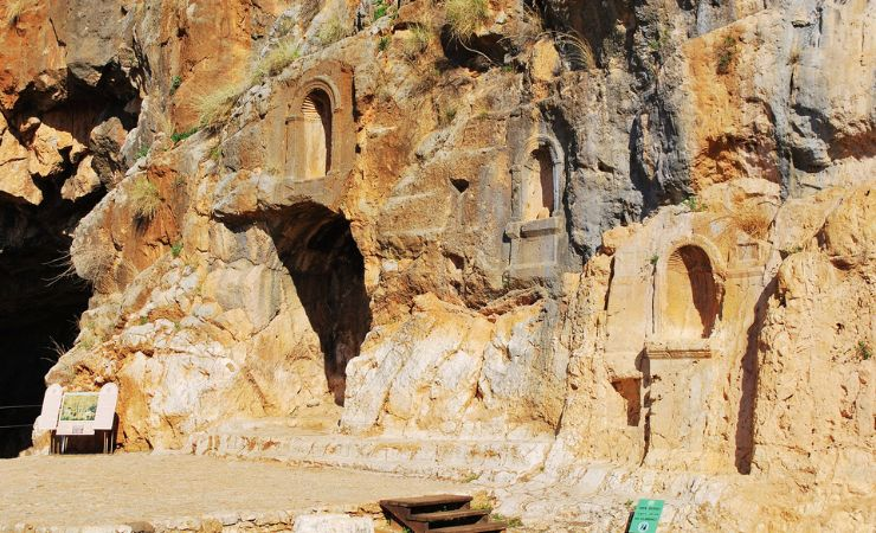
It is Jesus who builds the church. The church belongs to him. The apostles and other Christians play supporting roles, and those roles are important. However, Jesus has the lead role.
Jesus also said to Peter, “I will give to you the keys of the Kingdom of Heaven, and whatever you bind on earth will have been bound in heaven; and whatever you release on earth will have been released in heaven.”
After Jesus’ resurrection, he would tell the disciples (not Peter alone), “Receive the Holy Spirit! If you forgive anyone’s sins, they have been forgiven them. If you retain anyone’s sins, they have been retained” (John 20:22-23).
Jesus finally commanded the disciples that they should tell no one that he was the Christ. Jesus was not yet ready for the disciples to tell the world his secret. The world was not ready to hear the secret, and the disciples were not yet ready to reveal the secret accurately. Jesus would alter tell the disciples what to expect from his Messiahship—his death and resurrection—and Peter would protest mightily, prompting a sharp rebuke from Jesus.
Jesus would not allow the disciples to reveal his Messiahship that until they understood what that actually entailed. They would not really understand until they saw the resurrected Christ. That would come soon enough.