Parable of the Vine-Growers
“Listen to another parable. There was a landowner who planted a vineyard and put a wall around it and dug a wine press in it, and built a tower, and rented it out to vine-growers and went on a journey.
Now when the harvest time approached, he sent his slaves to the vine-growers to receive his fruit. And the vine-growers took his slaves and beat one, and killed another, and stoned a third. Again, he sent another group of slaves larger than the first; and they did the same thing to them.
But afterward he sent his son to them, saying, ‘They will respect my son.’ But when the vine-growers saw the son, they said among themselves, ‘This is the heir; come, let us kill him and seize his inheritance.’ And they took him, and threw him out of the vineyard and killed him.
Therefore, when the owner of the vineyard comes, what will he do to those vine-growers?” They said to Him, “He will bring those wretches to a wretched end, and will rent out the vineyard to other vine-growers who will pay him the proceeds at the proper seasons.”
Jesus said to them, “Did you never read in the Scriptures,
‘The stone which the builders rejected, This has become the chief corner stone; This came about from the Lord, And it is marvellous in our eyes’?
Therefore, I say to you, the kingdom of God will be taken away from you and given to a nation, producing the fruit of it. And he who falls on this stone will be broken to pieces; but on whomever it falls, it will scatter him like dust.”
And when the chief priests and the Pharisees heard His parables, they understood that He was speaking about them. And although they were seeking to seize Him, they feared the crowds, because they were regarding Him to be a prophet.
The Parable of the Tenants, also known as the Parable of the Wicked Tenants, is a significant teaching of Jesus Christ found in the Synoptic Gospels: Matthew 21:33-46, Mark 12:1-12, and Luke 20:9-19. In this parable, Jesus tells the story of a landowner who plants a vineyard, rents it to tenants, and leaves for a long time. At harvest time, the tenants beat and mistreat the servants sent by the landowner, and when the owner sends his son, they kill him. The parable illustrates the consequences of rejecting God's messengers [the prophets] and the divine judgment that will come upon those who are wicked. It serves as a warning to the religious leaders of Jesus' time and is a profound allegory that addresses themes of stewardship, rejection, and divine judgment.
Context and Setting
The parable is delivered by Jesus during the final week of His earthly ministry, shortly after His triumphal entry into Jerusalem. It is part of a series of confrontations between Jesus and the religious authorities, who question His authority. The setting is a vineyard, a common theme in Jewish literature, symbolizing Israel (Isaiah 5:1-7).
Narrative Summary
In the parable, we are told that a landowner plants a vineyard, he then equips it with all necessary facilities, and leases it to tenants before traveling to another country. At harvest time, the landowner sends servants to collect his share of the fruit. The tenants, however, beat one servant, kill another, and stone a third. The landowner sends more servants, but they receive the same treatment. Finally, he sends his son, thinking they will respect him. Instead, the tenants conspire to kill the son, hoping to seize his inheritance. The parable concludes with the landowner's return and the severe punishment of the wicked tenants.
Interpretation and Themes
1. The landowner represents God, and the vineyard symbolizes Israel, entrusted to the care of its leaders. The imagery of the vineyard is deeply rooted in Old Testament prophecy, particularly in Isaiah 5, where Israel is depicted as a vineyard that fails to produce good fruit.
2. The tenants are the religious leaders of Israel, including the chief priests, scribes, and elders. They are entrusted with the spiritual care of the people but fail in their duties, rejecting God's messengers.
3. The servants sent by the landowner symbolize the prophets sent by God throughout Israel's history. Their mistreatment and murder reflect Israel's historical rejection of prophetic voices.
4. The son represents Jesus Christ, the beloved Son of God. His murder by the tenants foreshadows Jesus' impending crucifixion at the hands of the religious leaders.
5. The parable concludes with the landowner's judgment upon the tenants, which signifies God's impending judgment on Israel's leaders. The vineyard is given to others, symbolizing the transfer of God's kingdom to a people who will produce its fruits, often interpreted as the inclusion of the Gentiles and the establishment of the Church.
Reactions and Implications
The religious leaders perceive that Jesus is speaking against them, as noted in Matthew 21:45-46: "When the chief priests and Pharisees heard His parables, they knew that He was speaking about them. Although they wanted to arrest Him, they feared the crowds, because they considered Jesus a prophet."
The parable serves as a stern warning about the consequences of rejecting God's messengers and His Son. It emphasizes the responsibility of spiritual leaders to faithfully steward God's people and the inevitable judgment that follows unfaithfulness.
Luke 21:5-36
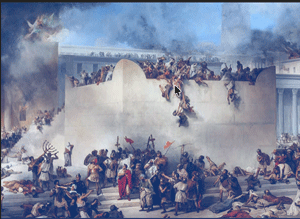
And while some were talking about the temple, that it was adorned with beautiful stones and votive gifts, Jesus said, “As for these things which you are looking at, the days will come in which there will not be left one stone upon another which will not be torn down.”
In the year 70 AD, the city of Jerusalem endured one of the most brutal and consequential sieges in ancient history. For seven long months, the military juggernaut of the Roman Empire unleashed its full fury against the outnumbered Jewish rebels, culminating in the complete destruction of the sacred Second Temple. The fall of Jerusalem marked the catastrophic end of the First Jewish-Roman War (66-73 AD) and resulted in widespread slaughter, enslavement, and dispersion. This catastrophic event forever changed the course of Jewish history and had seismic religious and geopolitical aftershocks that still reverberate nearly two thousand years later.