Today we think of the gravity of Our Lord Jesus Christ, as King of the Universe, commonly referred to as the Feast of Christ the King, Christ the King Sunday or Reign of Christ Sunday, it is a feast day in the liturgical year which emphasises the true kingship of Christ.
The True Kingship of Christ
The True Kingship of Christ points to His divine authority, eternal reign, and fulfillment of Old Testament prophecies concerning the Messiah. This concept is deeply rooted in both the Old and New Testaments, where Christ is depicted as the promised King who fulfills the prophecies of the Hebrew Scriptures and reigns eternally. The anticipation of a coming king is woven throughout the Old Testament, with the Davidic Covenant in 2 Samuel 7:12-16 promising that David's throne will be established forever. The New Testament presents Jesus as the fulfillment of these messianic prophecies, affirming His identity as the True King. Christ's kingship is not only spiritual but also involves a twofold influence on His subjects: an interior influence of supernatural life and an exterior influence of government. As the Head of the Church, Christ guides the mystical Body towards Eternal Happiness and determines the proper sanctions for His precepts. Which the parable speaks to.
In this reading we hear the final public lesson in the form of a parable of Jesus that is recorded in the Gospel of Matthew, which is commonly known as The Parable of the Sheep and the Goats or The Judgment of the Nations.
In the parable we are told that when Jesus returns in glory as the Son of Man, he will be accompanied by angels, he will sit on His glorious throne and then gather all nations before Him. And like a shepherd he will separate and divide sheep from goats. In reality Jesus will separate people into two specific groups, placing the righteous ("sheep") on His right hand and the unrighteous ("goats") on His left hand.
The King [Jesus] will invite those on His right to inherit the kingdom prepared for them from the foundation of the world.
These are they that fed the hungry, gave drink to the thirsty, welcomed the stranger, clothed the naked, cared for the sick, and visited the imprisoned.
However, these individuals will be surprised by this, as the righteous ask when they ever saw Jesus in those conditions. In the text The King replies, "Truly I tell you, whatever you did for one of the least of these brothers and sisters of mine, you did for me".
The King tells those on his left to depart into eternal fire prepared for the devil and his angels. These individuals are judged not for active malice alone, but for failing to perform acts of mercy and service in their lives.
By neglecting the vulnerable and the needy is the same as neglecting Jesus Himself.
Note salvation is not earned by good deeds but genuine saving faith naturally produces outward fruit and love for others (especially fellow believers/disciples in need), rather than salvation being a wage earned by human merit.
The parable of the sheep and goats is Jesus’ final parable. Sometimes you save the best for last—it might be considered as a summary of what he was teaching the whole time that he was on earth.
Jesus speaks of a final judgment and a great division of the nations. Notice that it’s not just individuals but also of nations. Jesus tells us that God judges societies or nations by how well they care for the poor and marginalized communities.
How well do you think the world is doing? How well do you think our local communities are doing?
How many people are homeless in our community? How well are they cared for? How many people have little or no food to eat in our community?
How well do we care for those in our prisons? Our criminal justice system has largely dissolved into pure punishment centres without little hope of any true form of rehabilitation. By the time they get released, many inmates become worse criminals after prison than before they went in.
How well do we care for the sick and those that face forms of addiction?
In short how do our societies treat the most needy and marginalised people in its midst?
We all should structure our lives to move from simple good intentions to real and good actions. The sheep in the passage are those who do factual faith, not those who just possess faith.
This parable teaches us that helping those we encounter and encouraging them is actually serving the Lord and it is a way that we love God. We are to develop our relationship with Jesus and others in our daily life in gratitude. Love our God with all our heart, with all our soul, with all our strength, and with all our mind. And to love our neighbours as ourselves each and every day.
Now: When the Pharisees heard that Jesus had left the Sadducees speechless, they met together. One of them, a legal expert, tested him and asked. “Teacher, what is the greatest commandment in the Law?”
Jesus replied, “You must love the Lord your God with all your heart, with all your being, and with all your mind. This is the first and greatest commandment. And the second is like it: You must love your neighbour as you love yourself. All the Law and the Prophets depend on these two commands.”
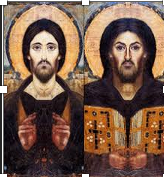
The icon depicts both Christ as divine judge on the right and Christ as the God of mercy on the left. As faithful Christians it is clear for us that Christ, is fully human and fully divine, and shares fully in the divine attributes, which include justice and mercy. What is so striking about this icon is its insistence that we do not become so focused on one that we lose sight of the other.